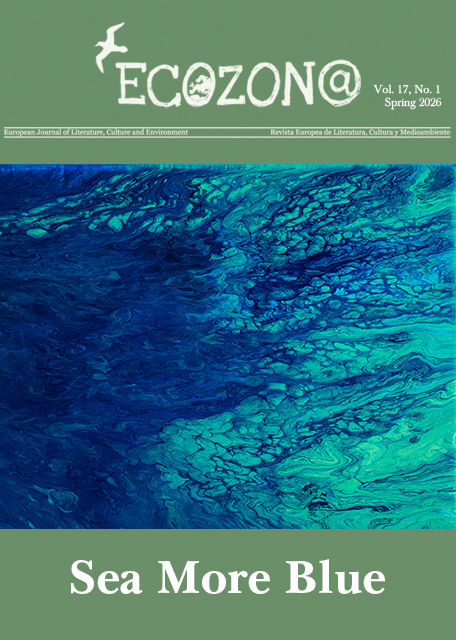
"Écume" by Véronique Bergen. From Oceanic Ecocide to a New Alliance with all Living Beings
DOI:
https://doi.org/10.37536/ECOZONA.2026.17.1.5886Keywords:
Moby-Dick by Melville, ecological crisis, ocean imaginary, water, whaleAbstract
Écume (2023), a novel by Belgian author Véronique Bergen, revisits one of the major narratives that has shaped our oceanic imagination and contributed to our separation from the sensuous world: Moby-Dick by Herman Melville. One of the most original aspects of the book is its unexpected, surging prose, which we will highlight for its affinities with aqueous and oceanic matter. We will also show that the oceanic imaginary and humanity’s relationship to the sea, as portrayed in this novel of the Anthropocene, are grounded in predation, technicism, and the sublime – features characteristic of the “Atlantic perspective” (Artaud). Écume, a testament to the oceanic turn that emerged forcefully two decades ago, denounces the extreme degradation of seas and oceans and brings to visibility the nonhuman beings that inhabit them. Finally, we will examine the alliances, the (re)connections to the marine world and to life, and the more-than-human “becomings” (Deleuze) enacted in the novel, particularly through its main female character – a “body of water” (Neimanis).
Downloads
Downloads
Published
Issue
Section
License
Authors who publish with this journal agree to the following terms:
a) Authors retain copyright and grant the journal right of first publication with the work simultaneously licensed under a Creative Commons Attribution License that allows others to share the work with an acknowledgement of the work's authorship and initial publication in this journal (CC BY-NC for articles and CC BY-NC-ND for creative work, unless author requests otherwise.
b) Authors are able to enter into separate, additional contractual arrangements for the non-exclusive distribution of the journal's published version of the work (e.g., post it to an institutional repository or publish it in a book), with an acknowledgement of its initial publication in this journal.
c) Authors are permitted and encouraged to post their work online (e.g., in institutional repositories or on their website) prior to and during the submission process, as it can lead to productive exchanges, as well as earlier and greater citation of published work (See The Effect of Open Access).