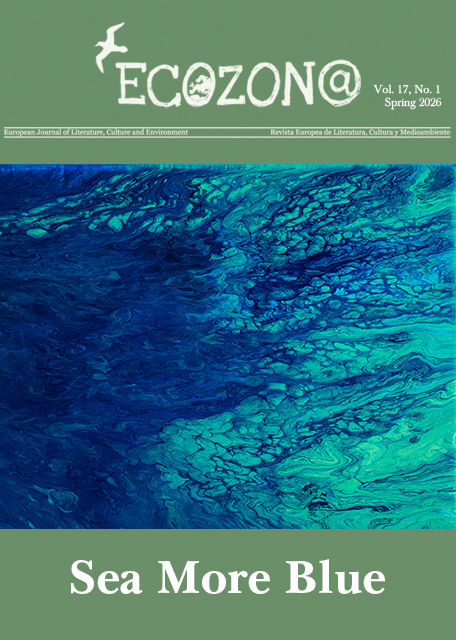
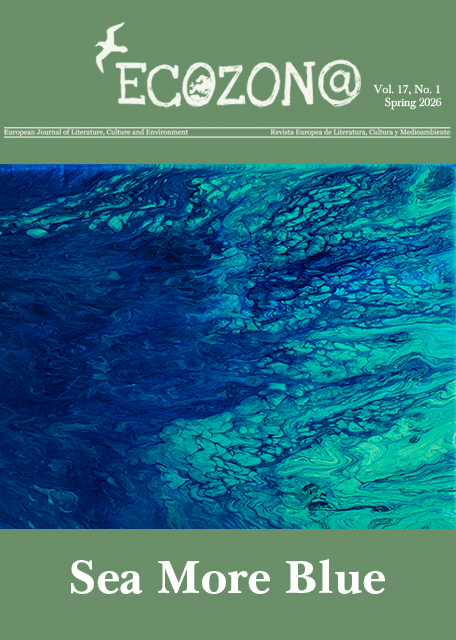
'See below the surface of the waves': Blue Anti-Human Exceptionalism in Richard Powers’ "Playground"
DOI:
https://doi.org/10.37536/ECOZONA.2026.17.1.5889Keywords:
anti-human exceptionalism, blue ecocriticism, "Playground", Richard PowersAbstract
This article analyzes the literary expression of blue anti-human exceptionalism in Richard Powers’ novel Playground (2024). I argue that the novel deconstructs human exceptionalism, staging three parallel strategies. First, contrary to much maritime literature from the 19th and 20th centuries, it focuses on the very materiality of the ocean and the vividness of submarine life, thus making oceanic life visible. Second, it humanizes oceanic organisms by comparing their attitudes to those of humans and translating their language into human-understandable terms. Moreover, the novel shows that submarine organisms are much more similar to humans than they think. For example, it highlights mantas’, cuttlefishes’, and sea otters’ capacities for play, perception, and maternal care. At the same time, Playground depicts oceanic species, marked by features that make them unique. It often resorts to the ecological sublime by staging the semantic fields of amazement and incomprehensibility concerning many underwater mechanisms. In this way, the novel shows that humans cannot demand to understand any aspect of non-human life.
Downloads
Downloads
Published
Issue
Section
License
Authors who publish with this journal agree to the following terms:
a) Authors retain copyright and grant the journal right of first publication with the work simultaneously licensed under a Creative Commons Attribution License that allows others to share the work with an acknowledgement of the work's authorship and initial publication in this journal (CC BY-NC for articles and CC BY-NC-ND for creative work, unless author requests otherwise.
b) Authors are able to enter into separate, additional contractual arrangements for the non-exclusive distribution of the journal's published version of the work (e.g., post it to an institutional repository or publish it in a book), with an acknowledgement of its initial publication in this journal.
c) Authors are permitted and encouraged to post their work online (e.g., in institutional repositories or on their website) prior to and during the submission process, as it can lead to productive exchanges, as well as earlier and greater citation of published work (See The Effect of Open Access).