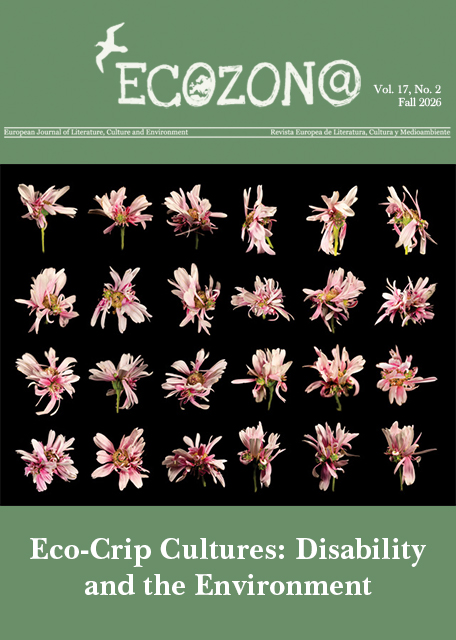
Debilitating Ecologies: Eco-crip Resistance in Saro-Wiwa’s "A Month and a Day" and Agary’s "Yellow-Yellow"
DOI:
https://doi.org/10.37536/ECOZONA.2026.17.2.6088Keywords:
eco-crip theory, debility, Niger Delta, environmental justice, slow violenceAbstract
This paper examines the intersections of disability and environmental degradation in Nigeria’s Niger Delta through an eco-crip lens, focusing on Ken Saro-Wiwa’s A Month and a Day: A Detention Diary (1995) and Kaine Agary’s Yellow-Yellow (2006). Drawing on Jasbir Puar’s concept of debility and Rob Nixon’s “slow violence,” it argues that these texts represent the debilitating effects of oil pollution—poisoned air and water, threatened food supplies, reproductive harm, and communal dysfunction—as environmentally induced disabilities. This approach addresses the absence of conventional Western disability representations in Nigerian literature while critiquing ableist and extractive norms perpetuated by oil companies and state complicity. Saro-Wiwa’s memoir foregrounds Ogoni health crises and activist resistance via the Movement for the Survival of the Ogoni People, while Agary’s novel illuminates gendered debility, such as the reproductive harms to which poverty, displacement, and environmental ruin expose women, infusing the eco-crip perspective with feminist agency. Employing a cultural studies approach, this article responds to the non-hierarchical appraisals of diverse embodiments, emphasising tensions and toxicities in Delta spaces and bodies. By juxtaposing Saro-Wiwa’s activism with Agary’s feminist narrative, it reimagines well-being through plural contributions, situating the Delta’s struggle within broader African environmental justice discourses.
Downloads
Downloads
Published
Issue
Section
License
Authors who publish with this journal agree to the following terms:
a) Authors retain copyright and grant the journal right of first publication with the work simultaneously licensed under a Creative Commons Attribution License that allows others to share the work with an acknowledgement of the work's authorship and initial publication in this journal (CC BY-NC for articles and CC BY-NC-ND for creative work, unless author requests otherwise.
b) Authors are able to enter into separate, additional contractual arrangements for the non-exclusive distribution of the journal's published version of the work (e.g., post it to an institutional repository or publish it in a book), with an acknowledgement of its initial publication in this journal.
c) Authors are permitted and encouraged to post their work online (e.g., in institutional repositories or on their website) prior to and during the submission process, as it can lead to productive exchanges, as well as earlier and greater citation of published work (See The Effect of Open Access).