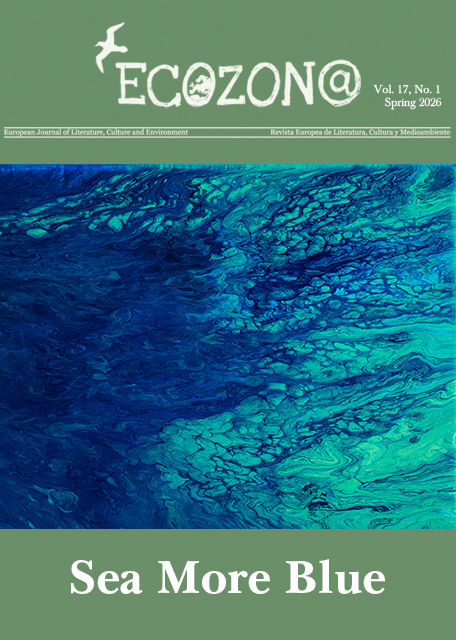
Water Specters and Sea Changes by Women Surrealists: Re-envisioning Poe’s Maritime Gothic
DOI:
https://doi.org/10.37536/ECOZONA.2026.17.1.5890Keywords:
maritime gothic, women surrealists, Edgar Allan Poe, Leonor Fini, Dorothea TanningAbstract
For the Surrealists, the sea was inspiring due to its sociobiological construction, its allure of voyages to the unknown, and its psychodynamic connection with the unconscious. Women artists, too, revised the tropes of the sea, particularly elaborating on the maritime Gothic (nightmarish shipwrecks, vortexes, trapped treasures, and bodies) as a means of resurgence for the oppressed, as well as the repressed. This analysis is based on artwork from women who engaged with Edgar Allan Poe’s writings (especially Dorothea Tanning and Leonor Fini), particularly focusing on the novel The Narrative of Arthur Gordon Pym, and contrasting interpretations with their male counterparts. The central inquiry will be on how these women, without discarding the energy of the logocentric subversion of the masculine artists, experimented with putting versions of themselves into their paintings, and tended to feminize the Gothic. They achieved this through the imagery of pubescent or latent figures, as well as nursing motherly figures, and by exploring their entanglement with other species, as well as the links between the unconscious and the more-than-human elements that dwell, and often subside, in the sea.
Downloads
Downloads
Published
Issue
Section
License
Authors who publish with this journal agree to the following terms:
a) Authors retain copyright and grant the journal right of first publication with the work simultaneously licensed under a Creative Commons Attribution License that allows others to share the work with an acknowledgement of the work's authorship and initial publication in this journal (CC BY-NC for articles and CC BY-NC-ND for creative work, unless author requests otherwise.
b) Authors are able to enter into separate, additional contractual arrangements for the non-exclusive distribution of the journal's published version of the work (e.g., post it to an institutional repository or publish it in a book), with an acknowledgement of its initial publication in this journal.
c) Authors are permitted and encouraged to post their work online (e.g., in institutional repositories or on their website) prior to and during the submission process, as it can lead to productive exchanges, as well as earlier and greater citation of published work (See The Effect of Open Access).