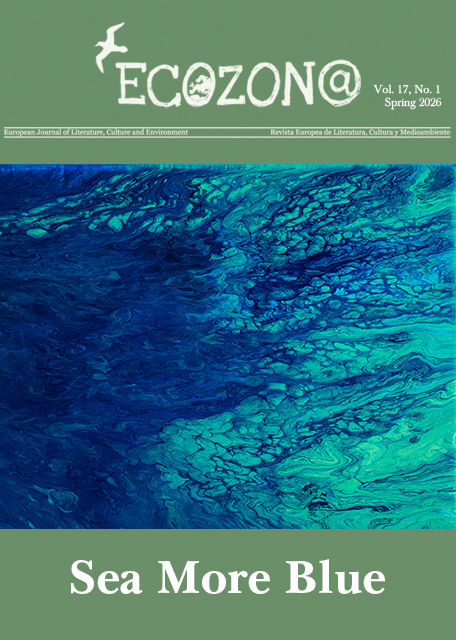
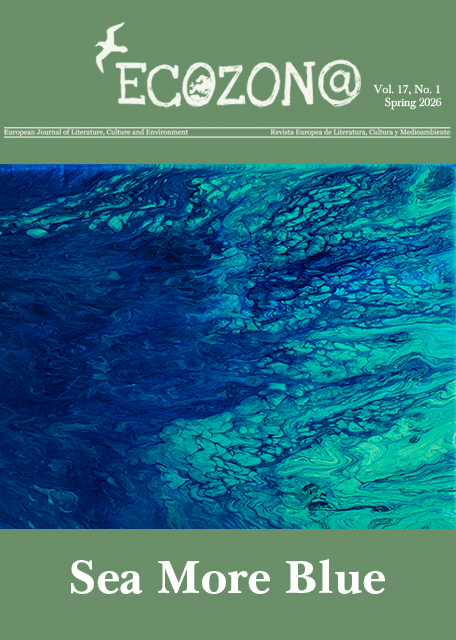
Rootedness and Uprootedness in "Aguas" by Alicia Genovese: A(n) (Under)water Exploration
DOI:
https://doi.org/10.37536/ECOZONA.2026.17.1.5893Keywords:
poetry, Argentina, rootedness, hydrofeminismAbstract
In Aguas (2013), the Argentinean poet Alicia Genovese explores the relationship between her human (and non-human) characters and water: “some sense of us” (Genovese 33). Drawing on the concepts of “uprootedness” and “rootedness” formulated by Binns (2002) this article explores the tension, omnipresent in Genovese's poems, between problematic dualisms and the quest for a symbiotic unity. The alienation of the human being (uprootedness), observed by Binns in the context of the environmental crisis, and his desire to regain a sense of interconnectedness (rootedness) manifest themselves in Aguas on three different levels: the world, the individual, and art. In Genovese's poetry, the characters' come back to a deep connection with water—and, by extension, with the world in all its plurality—is accompanied by a return to their bodies and sensations—in reaction to excessive rationalism—and to poetry—an ancestral and constantly renewed genre, halfway between the rational and the irrational. A close reading of Genovese's work highlights how these three reconnections are intrinsically linked and how this offers an alternative to the “modern water” paradigm described by Linton (14). The paper demonstrates that Genovese's texts seek to overcome the destructive dualism of a world divided between water and thought by creating, through a poetry of swimming, an alternative imaginary that explores the extent to which “water is a complete poetic reality” (Bachelard 23), i.e. both abstract and material.
Downloads
Downloads
Published
Issue
Section
License
Authors who publish with this journal agree to the following terms:
a) Authors retain copyright and grant the journal right of first publication with the work simultaneously licensed under a Creative Commons Attribution License that allows others to share the work with an acknowledgement of the work's authorship and initial publication in this journal (CC BY-NC for articles and CC BY-NC-ND for creative work, unless author requests otherwise.
b) Authors are able to enter into separate, additional contractual arrangements for the non-exclusive distribution of the journal's published version of the work (e.g., post it to an institutional repository or publish it in a book), with an acknowledgement of its initial publication in this journal.
c) Authors are permitted and encouraged to post their work online (e.g., in institutional repositories or on their website) prior to and during the submission process, as it can lead to productive exchanges, as well as earlier and greater citation of published work (See The Effect of Open Access).