Swimming with the Trouble: Hydrofeminism Love and the Sea Cure in Deborah Levy's "Hot Milk" (2016)
DOI:
https://doi.org/10.37536/ECOZONA.2026.17.1.5879Schlagworte:
blue humanities, hydrofeminism, queer ecology, sea cure, "Hot Milk", jellyfish, becoming-animalAbstract
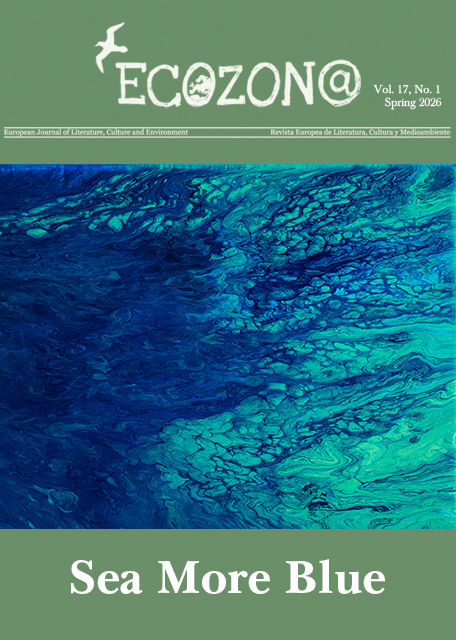
Deborah Levy’s salty, ruminative novel Hot Milk (2016) follows a young woman, Sofia, as she travels from England to Almería, Spain in search of a cure for her mother Rose’s many ailments. Sofia begins swimming in the Mediterranean, where she is repeatedly stung by medusas who have, she learns, grown abundant from overfishing (3). These medusas sting her “into desire” (72) and into a queer sexual awakening, acting not only as material agents but also as symbolic, rebellious creatures that recall the monstrous Gorgon of Hélène Cixous’s “The Laugh of the Medusa” (1976), which is excerpted in the novel’s epigraph. In this essay, I argue that Hot Milk looks back to a cultural and literary tradition of writing about the “sea cure,” but with a key ecological twist: what happens to the sea cure when the ocean itself is sick? Thick with medusas, polluted by gasoline spills, and flanked by dunes of cement powder (23,167), the Mediterranean acts not as a salubrious backdrop for Rose’s healing, but rather as a dynamic force that interacts with the bodies of Sofia and her lovers Ingrid and Juan as they swim in its waters and that, like the characters of the novel, is marked by its own ailments and afflictions. Considering this, I argue, expands our understanding of “sickness” or impairment as a designation and pathologization that flows across both human and nonhuman worlds in Hot Milk. In this way, the novel troubles an idealized cultural and literary trope of the restorative seaside by depicting, instead, watery communities of both human and marine life reckoning with anthropogenic harm.
Downloads
Downloads
Veröffentlicht
Ausgabe
Rubrik
Lizenz
Authors who publish with this journal agree to the following terms:
a) Authors retain copyright and grant the journal right of first publication with the work simultaneously licensed under a Creative Commons Attribution License that allows others to share the work with an acknowledgement of the work's authorship and initial publication in this journal (CC BY-NC for articles and CC BY-NC-ND for creative work, unless author requests otherwise.
b) Authors are able to enter into separate, additional contractual arrangements for the non-exclusive distribution of the journal's published version of the work (e.g., post it to an institutional repository or publish it in a book), with an acknowledgement of its initial publication in this journal.
c) Authors are permitted and encouraged to post their work online (e.g., in institutional repositories or on their website) prior to and during the submission process, as it can lead to productive exchanges, as well as earlier and greater citation of published work (See The Effect of Open Access).