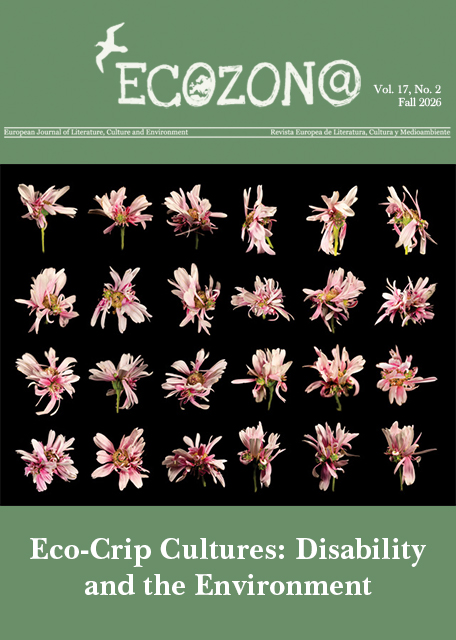
Cripping the Eco-Disaster: Imagining Disability Ecologies in Indra Sinha’s "Animal’s People" and Veena Nagpal’s "Radius 200"
DOI :
https://doi.org/10.37536/ECOZONA.2026.17.2.6082Mots-clés :
transcorporeality, disability ecology, Indian English fiction, eco-disaster, slow violenceRésumé
By examining the representation of toxic cityscapes in two Indian English novels, namely Radius 200 by Veena Nagpal (2014) and Animal’s People by Indra Sinha (2007), this essay situates eco-crip theory in a postcolonial context and argues that these novels envision post-disaster cities in the Global South as disabled, as well as disabling, thereby inextricably entangling the human and the more-than-human in a web of mutual vulnerabilities. Drawing on Stacy Alaimo’s concept of trans-corporeality (2010) as well as Pramod K. Nayar’s concept of ecoprecarity (2019), I claim that these novels negotiate new forms of human/more-than-human enmeshment that challenge normative approaches to disability and point towards epistemological re-framings of thinking about disabled bodies and their relation to the ‘environment’, as well as towards the different global distribution of precarity and vulnerability. While Indra Sinha’s Animal’s People is a fictionalisation of the aftermath of the 1984 Bhopal Disaster in India, where a chemical gas leak in a pesticide factory killed thousands of people and animals as well as leaving thousands more chronically ill, Veena Nagpal’s Radius 200 is set in an India of a not-so-distant future, in which a rivalry over water resources between India and China results in a Chinese nuclear attack on the city of Allahabad, creating a 200 mile-radius Exclusion Zone in which a group of survivors is left to fend for itself. Yet by envisioning new forms of community, mutual vulnerabilities and material entanglements between the human and the more-than-human in post-disaster cities, I further claim that these novels depict utopian moments, in Caroline Edward’s sense (2019), that offer glimpses of hope and resilience in the face of changing climate conditions.
Téléchargements
Téléchargements
Publié-e
Numéro
Rubrique
Licence
Authors who publish with this journal agree to the following terms:
a) Authors retain copyright and grant the journal right of first publication with the work simultaneously licensed under a Creative Commons Attribution License that allows others to share the work with an acknowledgement of the work's authorship and initial publication in this journal (CC BY-NC for articles and CC BY-NC-ND for creative work, unless author requests otherwise.
b) Authors are able to enter into separate, additional contractual arrangements for the non-exclusive distribution of the journal's published version of the work (e.g., post it to an institutional repository or publish it in a book), with an acknowledgement of its initial publication in this journal.
c) Authors are permitted and encouraged to post their work online (e.g., in institutional repositories or on their website) prior to and during the submission process, as it can lead to productive exchanges, as well as earlier and greater citation of published work (See The Effect of Open Access).