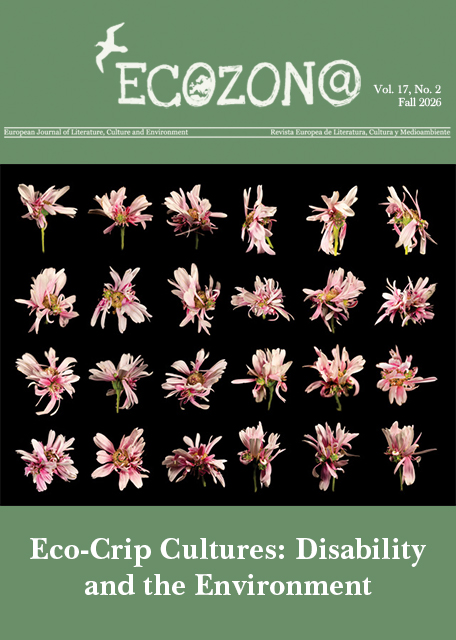
Metamorphosis Towards Human-Vegetal Hybrids, From utopia to Dystopia and Back: A Mirrored Reading of Franci Conforti’s "Carnivori" and Clelia Farris’s "I vegumani"
DOI :
https://doi.org/10.37536/ECOZONA.2026.17.2.5558Mots-clés :
Climate fiction, Dystopie/utopie, Hybridization, Littérature italienne, PlantesRésumé
This article proposes a compared reading of two contemporary Italian novels: Carnivori, by Franci Conforti, and I vegumani, by Clelia Farris. Their stories, both located in a remote future, revolve around the common premise of a plan to hybridize humans with plants, in order to better face current vital issues, such as climate change and the issue of feeding the whole human population. Despite significant common points, the two novels diverge in their trajectories, insofar as the former starts from a partially utopian situation and ends on a dystopian and even apocalyptic note, in which the few human survivors are forced into exile on another planet, whereas the latter follows an exactly opposite path, hybridization being seen as the solution that prevents the necessity of exodus. This article explores the different factors that may explain this striking difference, including the SF subgenres to which the novels are related, the importance and relevance of plants in the stories (while there are almost completely absent from Carnivori, they are treated as full-fledged characters in I vegumani), and the ways hybridization is represented (as a loss of humanity and involution towards monstrosity vs as a vital enrichment of the characters’ identities and way of life). As I will argue, the different approaches of the two authors may be traced back to the opposite ideological stances they take with regard to a traditional, humanist view of human identity: adhering to it (Carnivori) or overcoming it in favour of a post-anthropocentric perspective (I vegumani).
Téléchargements
Téléchargements
Publié-e
Numéro
Rubrique
Licence
Authors who publish with this journal agree to the following terms:
a) Authors retain copyright and grant the journal right of first publication with the work simultaneously licensed under a Creative Commons Attribution License that allows others to share the work with an acknowledgement of the work's authorship and initial publication in this journal (CC BY-NC for articles and CC BY-NC-ND for creative work, unless author requests otherwise.
b) Authors are able to enter into separate, additional contractual arrangements for the non-exclusive distribution of the journal's published version of the work (e.g., post it to an institutional repository or publish it in a book), with an acknowledgement of its initial publication in this journal.
c) Authors are permitted and encouraged to post their work online (e.g., in institutional repositories or on their website) prior to and during the submission process, as it can lead to productive exchanges, as well as earlier and greater citation of published work (See The Effect of Open Access).